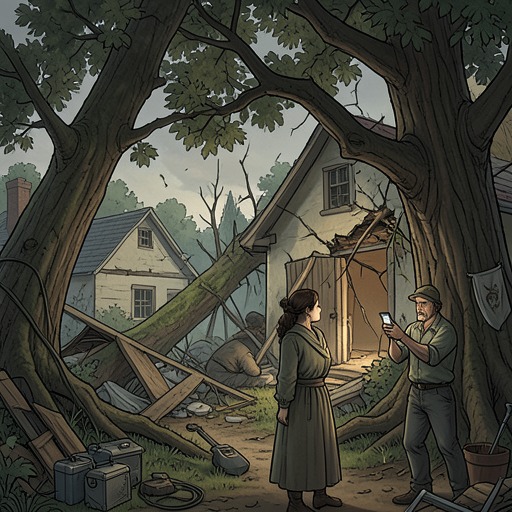
The Fallen Eucalyptus Tree
Shrill: Notes from a Loud WomanThe Fallen Eucalyptus Tree is the old eucalyptus that breaks in half during the Santa Ana winds and crushes the small yellow house the narrator had imagined as the home of a love story. The fall occurs amid several losses: she is alone in the bed she once shared with Ahamefule J. Oluo, he has told her he is leaving, and her father will die two weeks later. The tree’s destruction becomes both a literal upheaval and an image through which the narrator revisits the move, the relationship, and the family she left behind.
The Tree and the House
The tree falls while the narrator is sleeping alone. The house is already charged with the history of her relationship: it is the place she and Ahamefule J. Oluo moved into together in a new state, with plans she later recognizes as something she told herself to make the move seem right. By the time the tree comes down, he has told her he is leaving. The bed that used to belong to them makes that separation part of the scene before the damage to the house is even fully understood.
The next morning, leaves cover the windows, push through the screens and over the sills, and fill the view through the glass back door. The narrator sees leaves in a child’s room as well. The physical transformation is total: the familiar world inside the house seems to have been replaced. The Santa Ana winds have overwhelmed the old eucalyptus, which cracks in half and crushes the small yellow house.
A Move Reconsidered
The narrator places the collapse within a precise sequence of departures and losses. The tree falls eight weeks after she and Ahamefule J. Oluo move in together, four weeks after he tells her he is leaving, and two weeks before her father dies. Looking back four years later, she questions the idea that the couple left with grand plans and says the move had felt wrong before they left, throughout the drive south, and after they arrived.
That retrospective certainty sits beside an earlier memory of possibility. Two months before the move, after swimming in Lake Washington and playing with Ahamefule J. Oluo’s children, the narrator is mistaken for their mother at a garage sale. She panics and insists she is only a stranger, anxious not to suggest that she wants to become a family. The moment captures both her hope and her effort to contain it; later, the move gives that tentative relationship a shared home, even as the narrator’s account makes clear that the hope did not hold.
The route she recalls—through Oregon and California towns and then across Los Angeles streets—turns the move into a long sequence of places where, in hindsight, she believes things were already wrong. Her admission that she left her father, who was wrapped in a plaid blanket and leaning on her mother in the driveway, brings the family cost of that journey into focus. She remembers it as probably one of his last times out of bed. The fallen tree therefore belongs not only to the end of a romance but also to her later reckoning with the time away from her father.
Metaphor and Aftermath
The narrator recognizes how plainly the damaged house seems to illustrate the relationship: the little yellow house was supposed to be their love story, and the tree destroys it. She also calls the image too obvious for fiction, the kind of metaphor an editor would remove. That self-consciousness does not cancel the image; it draws attention to the gap between a life event and the neat symbolic meaning a story might impose on it. The tree’s fall is both actual storm damage and an interpretation the narrator knows may be too tidy.
The scene ends by returning from the ruined house to her father. Her mother calls in tears and says it is time; the narrator goes back to the airport. The sequence gives the tree’s collapse a place in a wider passage of separation: the shared home has been broken, her father is near death, and she must travel back to her family. The tree remains a concrete event that gathers those losses together without making them interchangeable.